

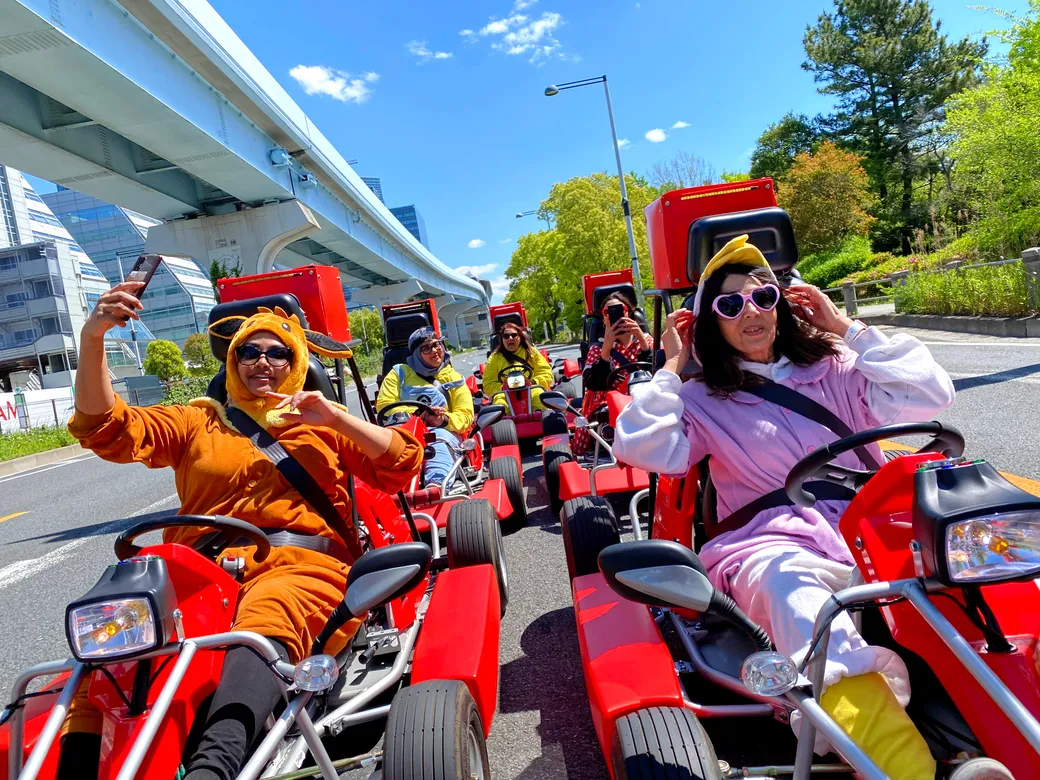
Feel Okinawa’s Ocean and Waterfront on a Street Kart Experience: Taking It Easy on the Route from Around Naha Airport to Senagajima
When people think about enjoying the sea on an Okinawa trip, many probably picture time spent on the beach or the views from a scenic lookout. But if you want to soak up the changing air on the way toward the water, and the feeling of the townscape gradually opening up as well, a street kart experience is an option that’s easy to consider. From the expressions of Naha’s streets to the impression of a widening sky the closer you get to the water—what makes this special is that you can take in that continuous change of scenery together with the act of moving itself.
In Okinawa, the functions of the city and the scenery of the coast sit relatively close together. Because of that, even in a short amount of time it’s easy to touch both the town and the sea, and depending on how you put your sightseeing together, it’s a region where you can pack a lot into a single day. Around Naha in particular, after feeling the flow of traffic and the liveliness of the urban area, the open feeling of heading toward the water gets added on top—so it leaves a slightly different impression than sightseeing that’s only about reaching a destination.
A street kart experience pairs well with these regional characteristics of Okinawa. You can see a wider area in a shorter time than walking, there’s a closeness to the open air that’s different from sightseeing from inside a car, and the changes along the road toward the coast are easy to take in not just visually but as a bodily sensation. In this article, for people who want to feel the atmosphere of Okinawa’s ocean and waterfront, we’ll lay out the features of the courses based on official public information, the conditions to check before booking, and how to fit it into your itinerary. You can check the courses and make reservations on the official site, kart.st, and the Okinawa shop page at https://kart.st/okinawa.html.
If you want to be conscious of coastal scenery in Okinawa, the travel time itself becomes the value
When sightseeing in Okinawa, seeing the sea itself isn’t hard. There are plenty of ways to spend your time—heading out along the coast, staying on a beach, or gazing out from a café or a lookout. But what stays with you about a trip is often not just the moment the sea comes into view, but the flow of the town’s density loosening up on the way there, with the impression of the wind and the spread of light changing along the way.
Around Naha, the elements of urban sightseeing and the scenery of the waterfront are relatively close to one another. There’s an Okinawa-like sense of openness in the flow from a stretch where you feel the buildings and traffic of the urban area, to the view opening up as you approach the area around the airport. Apart from sightseeing where you go around in fine detail on foot, for people who want to follow the scenery along a cohesive route, a street kart experience offers one way of seeing things.
What’s more, the guide-led format also makes the flow easy to grasp for people visiting Okinawa for the first time. Rather than free-roaming sightseeing where you search for your destination, you proceed along a set route, so you don’t get too caught up in deciding which way to go and can more easily keep your attention on the changing scenery moment to moment. It’s a different direction from a trip where you spend long stretches of time at the seaside itself, but it suits people who want to capture Okinawa’s waterfront not only as a “destination” but as “connected scenery.”
The 1-hour course makes it easy to feel both the hint of the sea around Naha Airport and the streetscape of Kokusai Street together
On the Okinawa shop’s official page, the 1-hour course is described as a flow that departs from the shop, heads toward the area around Naha Airport, enjoys the view of the sea, and then returns by way of Kokusai Street. For people who want to pick up Okinawa-like elements in a short amount of time, this setup is easy to understand. Rather than leaning entirely toward the sea, the liveliness of the town is also folded into the experience, so even within limited time it’s easy for variety to emerge in your impressions.
On the stretch heading toward the area around Naha Airport, a sense of scale a little different from the town center starts to appear. With better sightlines, a larger proportion of sky, and the addition of an atmosphere close to the water, it’s easy to feel Okinawa’s geographic closeness. Unlike sightseeing spots where you view the sea head-on, this becomes an experience where the hint of the sea spreads out partway through your movement, so the way you take in the scenery is continuous. This leads to a kind of enjoyment that’s a little different from sightseeing where you look at static scenery.
The flow of entering Kokusai Street afterward is another part that’s easy to point to as a feature of this course. Kokusai Street is an area that’s easily recognized as the center of Naha sightseeing, and it has an urban expression that differs from the openness of the coast. The structure of returning to the town’s energy after the view opens up near the sea makes you feel that Okinawa’s town and waterfront exist without being separated from one another.
Within a sightseeing schedule, this is a course that suits people with a short number of days or who want to combine it with other plans. It’s also easy to build an itinerary where you experience it compactly using one morning or afternoon slot, and fit a meal or other sightseeing before or after. If you want to go see Okinawa’s sea but don’t want to spend most of the day on the move, it’s content that’s easy to consider as a candidate.
The 2-hour course is for people who want to trace the impression of the waterfront a little more deeply, including Senagajima
On the official page, the 2-hour course is described as a longer itinerary that extends out to Senagajima and then returns by way of Kokusai Street. The required time is listed as 1.5 to 2 hours, on the premise that it varies with traffic conditions. Compared with the 1-hour course, the impression of touching the coastal scenery becomes somewhat richer, so it’s content that’s easy to consider for people who want to feel Okinawa’s coastal atmosphere.
Senagajima is known as a place that, while in a position with relatively easy access from central Naha, makes it easy to be conscious of your sense of distance from the sea. It’s introduced even in the official information as a place where you can enjoy coastal scenery, and it’s a route where you can expect a more waterfront-oriented openness that’s different from the scenery around Naha Airport. With a stretch that lets you feel the brightness of the sea’s surface and the bigness of the sky folded in, the contrast with urban scenery becomes clearer.
The point of this 2-hour course is that, rather than cutting out only the sea, you can experience the coastal scenery and the energy of the urban area as one continuous whole. Because the impression of the water grows stronger at Senagajima, and there’s then a flow of returning to Kokusai Street, it becomes easy to take in multiple expressions of an Okinawa trip as a single package. It suits people who want to see both a calm coastline and the liveliness typical of a sightseeing area.
It’s also content that suits people who want to enjoy the changes across the whole route, rather than moving with the sole aim of taking photos. The scenery doesn’t conclude in just one place; a stretch near the sea, a stretch returning to town, and a stretch where you feel urban liveliness all link together. Because of that, unlike sightseeing aimed at a single spectacular spot, it’s a course that’s easy to consider for people who want to take in the atmosphere of Okinawa as a flow.
When choosing a street kart experience in Okinawa, you’ll want to look not just at the scenery but at how easy the route is to follow
Sightseeing that’s about enjoying coastal scenery tends to come together even if you move intuitively after arriving on-site, but for hands-on activities the accuracy of your advance checks tends to affect your satisfaction. It’s the same with a street kart experience: it’s important to understand the course content, required time, necessary documents, and the flow of the day before you set out.
On the Okinawa shop’s official page, in addition to overviews of the 1-hour and 2-hour courses, you can check the shop’s location, access, and points to note when participating. The Okinawa shop is located at 7-1 Higashimachi, Naha City, Okinawa, and is described as a 4-minute walk from Asahibashi Station. Even if you build plans around the day you arrive at or depart from Naha Airport, it can be thought of as a location that’s easy to fold into a travel plan within Naha City. Looking at it together with where your hotel is and any plans around Kokusai Street makes it easier to picture your movements on the day.
The official page also notes that the courses differ for each shop. This means the Okinawa shop’s experience is built around Okinawa’s townscape and coastal scenery. Understanding it on the premise that it’s different from the Tokyo or Osaka routes—as content that includes Okinawa-like scenery—helps you align your expectations with the local characteristics.
The entry point for reservations can be checked at kart.st. Looking at it in advance together with the shop information makes it easier to compare what time slot you can fit it into your itinerary, and which of the 1-hour or 2-hour courses is the better fit. Whether you want to get a sense of the atmosphere around Naha in a short time, or to take in the impression of the waterfront a little more deeply including Senagajima, will change how you choose.
What you’ll want to check before booking: the driver’s license conditions and what to bring on the day
The most important thing before participating is checking the license conditions required for driving. The Okinawa shop’s official page explains that you need a valid Japanese driver’s license, an International Driving Permit, a SOFA license for those connected to the U.S. military in Japan, or—for some countries and regions—a combination of your home country’s license and an official Japanese translation. You can check the details on the official license guide page at https://kart.st/en/drivers-license/.
Because the handling of licenses differs by country and region, this is an item where it’s better not to proceed on the assumption that “I could drive overseas, so I’ll be fine in Japan too.” The official license page is structured so that you can check which licenses and permits are valid in Japan by country and region, so it’s important to cross-check your own conditions before you set out. Since there are cases where preparing missing documents won’t make it in time right before a trip, checking it at the same stage as arranging your flights and accommodation makes it easier to keep organized.
You also need to be careful about what you wear on the day. The Okinawa shop page advises avoiding heels, sandals, and long skirts. Okinawa has many periods when temperatures are high, and you may feel like dressing lightly, but it’s important to choose clothing suited to the experience so you don’t get too casual—especially on days you’re heading to the coast. If you have plans to stop by a beach or café before or after, keeping ease of changing clothes and ease of movement in mind makes it easier to put your plans together.
Furthermore, the official page advises arriving at the shop by 30 minutes before your reservation time. Road conditions and travel times within Naha City can change depending on the time of day, so if you’re heading there directly from the airport or moving from another sightseeing spot, it’s less stressful to give your itinerary some leeway.
If you’re thinking about Okinawa sightseeing that doesn’t end at the coast, you’ll want to focus on the continuity between town and waterfront
Okinawa’s appeal doesn’t conclude with the beauty of the sea alone. The convenience of Naha where urban functions gather, the liveliness around Kokusai Street, the openness of the area near the airport, the coastal scenery toward Senagajima—scenery with different characters is gathered within a relatively close range. That’s exactly why how you put together a single day changes the impression of the trip quite a bit.
A street kart experience is one form of sightseeing that makes that continuity easy to take in. Rather than making reaching the sea your only goal, you can watch Okinawa’s expressions shift from town to sea and from sea to town within a steady flow. With the 1-hour course, it’s easy to bundle the hint of the sea around Naha Airport and the urban air of Kokusai Street into a short time; with the 2-hour course, the image is of going around while layering on a bit more of the waterfront impression, Senagajima included.
If you want to value the time spent gazing at the sea in Okinawa while also making the act of moving itself a memory of the trip, this kind of route-style experience makes for an easy candidate to compare. You can check the details and the reservation route from the official site at kart.st, the Okinawa shop’s course overview at https://kart.st/okinawa.html, and the license conditions at https://kart.st/en/drivers-license/. Checking the official information in advance and then choosing the time allocation and course that fit your own itinerary is the basis for enjoying Okinawa’s sea and town without strain.
Our shop does not rent out costumes related to Nintendo or “Mario Kart.” We provide only costumes that respect intellectual property rights.
About Costumes
Our shop does not rent out costumes related to Nintendo or “Mario Kart.” We provide only costumes that respect intellectual property rights.
