
Naha in the Morning and at Dusk: A Street Kart Trip for Two Through Senagajima and Kokusai Street
Naha in the Morning and at Dusk: A Street Kart Trip for Two Through Senagajima and Kokusai Street
Kokusai Street in the morning light and Kokusai Street after the sun starts to sink look like two different places.
The road stays the same, but when the light changes, so does what you notice.
On a short trip for two, just deciding ahead of time what to see at which hour will change both your photos and your memories.
This article looks at how Naha changes from morning to evening, and how to plan the hours before and after your Street Kart tour around that.
What does Naha look like in the morning?
Kokusai Street is quiet in the morning.
The street was busy until late the night before, but now most shops still have their shutters down. A delivery truck is parked here and there, and a few people are getting ready to open.
The street is about 1.6 km long and famous as Naha's main tourist strip, but at this hour it's just an ordinary city street again. Last night's buzz has faded completely.
If you want photos, this quiet is the time to take them.
With so few people around, it's easy to frame a shot that runs all the way down the street. The low morning sun throws long shadows across walls and signs, which gives your photos more depth than you'd get at midday.
If there are two of you, one can stand near the middle of the street while the other steps back to show the street stretching away behind them. It's a shot that's hard to get once the daytime crowds arrive.
Remember where you stood and which way you were facing. If you include a sign or a corner shop as a landmark, it'll be easier to find the spot again later. On a day you spend the evening on Kokusai Street, you'll want this photo again.
Just off Kokusai Street is the Makishi Public Market, known as "Okinawa's Kitchen."
Go in the morning to see Okinawan ingredients laid out on the stalls, when the market feels at its liveliest.
Upstairs, restaurants will cook what you bought on the ground floor. You buy it, then go up and eat it. When I once brought a friend here, their eyes went wide at how this works, and I still remember the look on their face.
For a calmer morning, try walking Yachimun Street (Tsuboya Pottery Street).
"Yachimun" is the Okinawan word for pottery. The street is lined with pottery shops and cafés, and in the soft morning light the glazes look especially gentle.
It isn't flashy like Kokusai Street, and that makes it a good place for two people to stroll and talk.
If you want a taste of Ryukyu history, you could also go out to Shuri Castle, about 20 minutes by car from the shop. It was the royal palace of the Ryukyu Kingdom and is still being rebuilt after the 2019 fire. You can see Shureimon Gate and the site of the main hall in the morning while it's quiet, then head to your kart tour.
If you want a proper breakfast, C&C Breakfast on Kokusai Street serves an Okinawan-style breakfast.
Opening hours vary from shop to shop, so check Google Maps before you go.
How does the seaside change in the evening?
For an evening in Naha, try Senagajima.
It's a small island just south of Naha Airport. Senagajima Umikaji Terrace, with its rows of white buildings, looks a bit like a Mediterranean resort.
During the day, Senagajima's colors are strong.
The emerald sea and the white buildings stand out sharply against each other.
As the sun gets lower, those colors start to soften. The white walls turn orange, and the blue-green sea drifts toward a muted gold. Senagajima is a well-known sunset spot, and from here you can watch the sky and the sea change color together.
That said, the harder you try to get the perfect sunset photo, the worse it tends to go.
Either the sky is so bright that the two of you come out black, or you expose for your faces and the sky turns white. On a smartphone, the easiest fix is to shoot the two of you in silhouette against the sky.
One more tip: don't leave as soon as the sun goes down.
For a few minutes after sunset, the sky often turns a shade deeper, and photos taken then often look calmer.
You can also watch planes taking off from and landing at Naha Airport up close from Senagajima. Waiting for a plane to appear in the evening sky is a nice way to spend the time.
Grab an ice cream at the island's Blue Seal (an ice cream brand born in Okinawa) and wait for the next plane.
If it's one of the last evenings of your trip, it may tug at your heart a little.
On days you don't make it out to Senagajima, go back after dark to the part of Kokusai Street where you took your morning photo.
The shutters are up, the signs are lit, and there are far more people walking around than in the morning. Take another shot from the same spot, facing the same way, and put the two photos side by side. It's the same street, but they'll look like two different cities. It's crowded at this hour, so step to the side when you stop to take a picture so you don't block people walking by.
Blue Seal also has a shop on Kokusai Street, so you can get your ice cream there on days you don't reach Senagajima. If you're shopping for souvenirs, take a look inside Okashigoten, known for its purple sweet potato tarts, or Okinawa-ya while the street is lit up. The shops that had their shutters down in the morning are open for you to wander through in the evening.
Sunset times shift a lot with the seasons. Days are shorter in autumn and winter, and if you plan as if it's summer, it may already be dark when you arrive.
Check the sunset time for your day in a weather app the day before.
Naha from the seat of a kart: what changes with the time you ride?
Street Kart's Okinawa shop is in central Naha.
Depending on the course, the tour passes through central Naha (including Kokusai Street and the area around the Prefectural Office), along roads by the sea, around Naha Airport, and out to Senagajima.
Some courses run from Naha Airport toward Kokusai Street, and some stop at Senagajima along the way. Courses that pass Senagajima include a break on the island, so partway through the ride you get to step off your kart and look out at the sea.
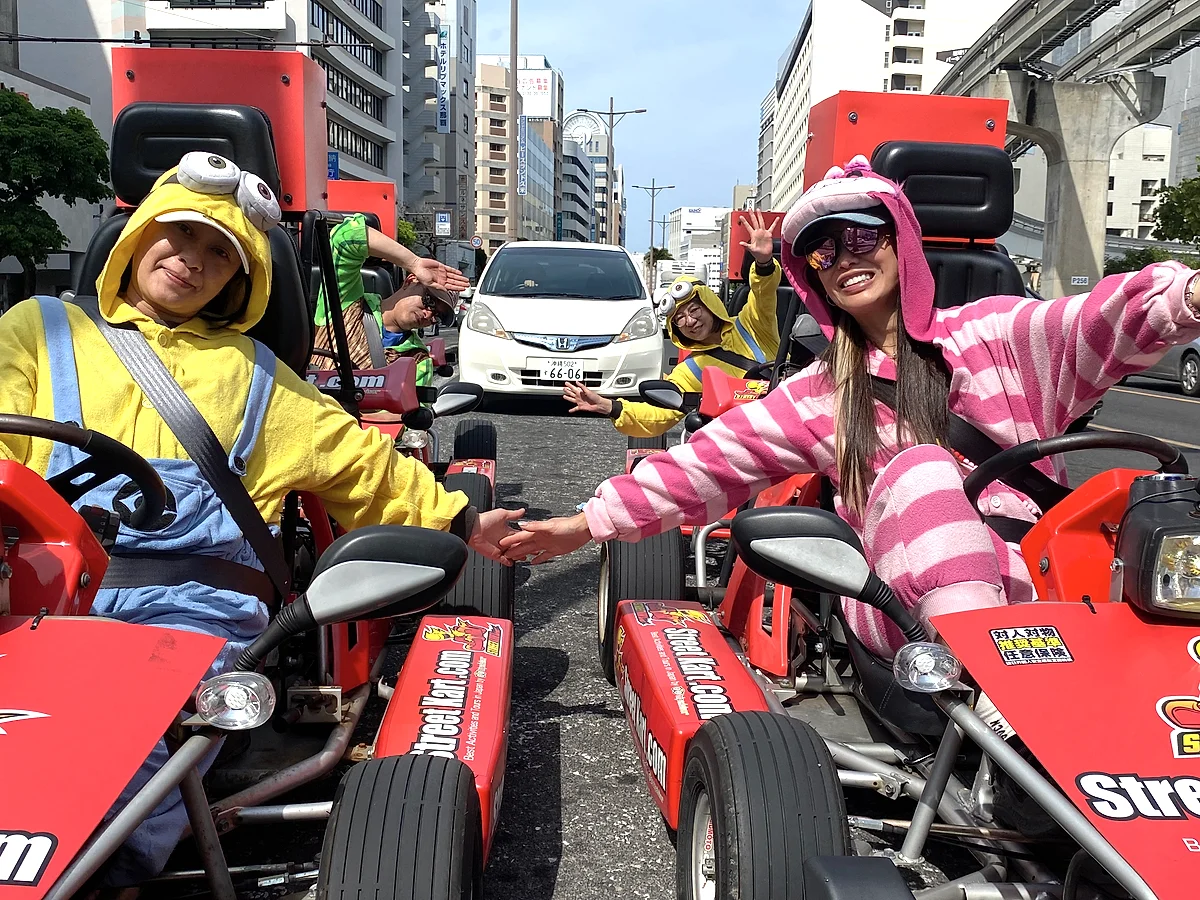
On the tour, you follow a guide along a set route. It helps to plan the scenery you'll see from the kart separately from what you'll see on foot before and after.
Before you set off, staff explain how to operate the kart, the route, and what to watch out for while riding. Everyone wears a helmet. You listen to the briefing, try out the controls, and then head out.
Your driver's license is also checked at reception. On days you walk to the shop after a morning stroll, it's easy to lose track of time at the market or the pottery shops, so wrap up early enough that you're not cutting it close to your booking time.
Once you're in the kart, you're sitting much lower than usual.
With the road so close, the street trees and buildings seem taller than usual. You suddenly notice things you normally ignore, like how wide the roads are or how the sky opens up above an intersection.
The wind and the sounds of the city reach you directly. When you come out by the sea, you can feel the air change on your skin.
From that low seat, light makes a bigger difference.
In the slanting morning light, building shadows stretch long across the road, and you pass through them again and again. When the sun is high, the strong sunlight makes the sea's colors pop. The closer it gets to evening, the more glare you get from office windows and the water, and the whole scene softens.
The same road shows you a different Naha depending on when you ride it.
Plan your outfit for the time you'll ride, too. Wear closed-toe shoes (sneakers are best) and clothes that are easy to move in. Avoid sandals, heels, skirts, and dresses. If you ride on a summer afternoon, sunglasses and sunscreen are handy. If you ride after the sun starts to go down, bring a jacket suited to the season.
If you're spending the morning at the beach before your ride, plan to shower and change before heading to the shop so you're not rushing.
If you'd like to ride at a particular time of day, check the official website for details, including which time slots can be booked.
For photos, use the time when you're not driving
Holding a phone while driving is dangerous, so it's best to take photos before and after the tour. For photos during the tour, follow your guide's instructions on the day.
It's easy to understand wanting photos of yourselves out on the road. But you can't take them with your hands on the wheel.
Instead, take a photo standing next to your karts in front of the shop, or snap each other getting ready before you set off.
During the tour, the group sometimes stops at photo spots. If you can take pictures while you're stopped, try putting the shadows stretching across the road in the background in the morning, or the color of the sky in the evening. The time of day you rode will show up right there in your photos.
If you make a point of taking these before-and-after shots, you'll end up with an album that lets you follow the whole trip when you look back on it.
If you keep shooting from the morning on Kokusai Street to the evening on Senagajima, your phone battery will drain faster than you expect. A power bank in a small bag will keep you from running out of battery right at the best moment of the sunset. Pack a drink in there too.
Before taking photos of staff or other participants, ask first.
Planning limited time on a trip for two
On a short trip for two, the simplest approach is to pick where you'll walk in the morning and where you'll be in the evening, then fit the kart tour in between.
If you're building your day around the morning, take photos on quiet Kokusai Street, walk through Makishi Public Market or Yachimun Street, and then head to the shop in time for your booking.
Kokusai Street and Makishi Public Market are about a 10-minute walk from the shop, and Yachimun Street is about 15 minutes. Both are walkable.
If you're building your day around the evening, head to Senagajima on your own after you get off the kart (separate from the tour route) and spend time at Umikaji Terrace until sunset.
Senagajima is about 15 minutes from the shop by car, so you'll probably take a taxi. Check which payment methods are accepted before you get in.
If you'd rather spend the evening within walking distance, Naminoue Beach, about 20 minutes on foot from the shop, is another option.
It's the only beach within Naha city, and Naminoue Shrine sits right beside it. You can get the sea and the shrine in the same shot, which makes it a good spot for evening photos.
Tomari Iyumachi, also about 20 minutes on foot, has a fish market and casual restaurants. It's ideal for days when you want to walk along the water and then have dinner there.
One thing to keep in mind:
The shop has no parking. Please come by public transportation or taxi. Many people get around Okinawa by rental car, so it's worth knowing this in advance.
If you're riding on the last day of your trip, think about your luggage as well. The shop's lockers are for small items and won't fit large luggage like suitcases. Decide ahead of time where you'll leave your big bags around hotel checkout so you can ride without carrying much.
And one more thing that matters especially for couples and pairs.
The karts are single-seaters, so you can't ride together. Each of you drives your own kart.
Instead of one person watching from the passenger seat, you each drive the same road and see it from your own seat.
Later, when one of you asks, "Remember the sky at that intersection?", I think you'll be able to talk about it together because you were both behind the wheel.
What to check before you book
On the tour, a trained guide drives at the front and participants follow behind.
Guidance on the day of the tour is generally in English. Whether Japanese guidance is available depends on the staff that day and isn't guaranteed. If you're unsure about following instructions in English, contact the shop before booking to check. See the official website (kart.st) for details. The website is available in 22 languages, so you can look things up before you book.
You need a valid driver's license that meets the shop's requirements to drive a kart.
Requirements vary by country and license type, so check the details on the official driver's license page.
If you only notice this right before your trip, it may be too late to sort out. Check it around the same time you book your flights.
Bookings are accepted via Facebook, LINE, and email, and contact details are listed on the official website.
Weekends tend to fill up, so booking early is recommended. Once you've settled your travel dates, start by asking about the day you'd like to ride.
Plans sometimes change after you've booked early. Cancellations are free up to 7 days in advance, so it's a good idea to jot that deadline in the margin of your itinerary.
Keep the weather in mind, too. Tours run as planned in light to moderate rain, and raincoats are provided free of charge. Tours are canceled in heavy rain or typhoons, and in that case you can choose to reschedule or get a refund. Longer courses may be shortened depending on the weather, in which case the price difference is refunded. And Kokusai Street in the rain looks different again from a sunny morning.
Prices vary by season and time of day, so check the official website for the latest rates.
Tour length and available time slots also vary by plan and date, so check those on the official website as well.
The quiet of Kokusai Street in the morning.
The evening on Senagajima as the colors of the sky shift.
And in between, the streets of Naha seen from a low seat.
Naha gives you a different view for every time of day you pick.
On your next trip to Okinawa, decide when you'll see things, not just what you'll see.
This article was originally written in Japanese and translated using AI. Some expressions may read unnaturally, and we appreciate your understanding. For the most accurate and up-to-date information, please refer to the official site at kart.st.
Street Kart is not affiliated with Nintendo or the Mario Kart series in any way. We do not provide costumes of Nintendo characters, and such costumes may not be worn during tours even if brought by participants.